Choosing the right pistol caliber is one of the most important decisions for anyone starting out in shooting sports or personal defense. It’s not just about power or accuracy—it’s about understanding how each cartridge behaves in terms of recoil, control, cost, and availability.
A common mistake among new shooters is choosing a caliber based on reputation or “stopping power,” rather than skill level and purpose. This guide breaks down the most popular calibers and helps you make a decision that’s both safe and smart.
What “Caliber” Really Means
A caliber refers to the internal diameter of a gun’s barrel, as well as the diameter of the bullet it fires. In handguns, the most common calibers range from .22 LR up to .45 ACP, with middle-ground options like .380 ACP, 9 mm Luger, and .40 S&W.
Each one offers a unique balance of muzzle energy, recoil, magazine capacity, and terminal performance, which determines how well it suits beginners versus experienced shooters.
Key Factors for Beginners: Control, Accuracy, and Cost
When starting out, three aspects matter most:
- Recoil management: a softer recoil helps you learn proper form without developing bad habits.
- Practical accuracy: the less your pistol jumps, the easier it is to keep your sights aligned for follow-up shots.
- Ammunition cost and availability: training effectively means shooting often, so ammo must be affordable and easy to find.
That’s why starting with low- or medium-powered calibers is far more productive than jumping straight to a heavy round.
The Most Popular Calibers for New Shooters
.22 Long Rifle (LR)
Perfect for first-time shooters. It produces minimal recoil and noise, and ammunition is extremely cheap. Ideal for developing trigger discipline and sight alignment, though it lacks significant stopping power.
.380 ACP (9 mm Short)
A practical option for concealed carry beginners. It offers light recoil and manageable handling, especially in compact pistols. Slightly more expensive than 9 mm, but easier for many shooters to control.
9×19 mm Parabellum (9 mm Luger)
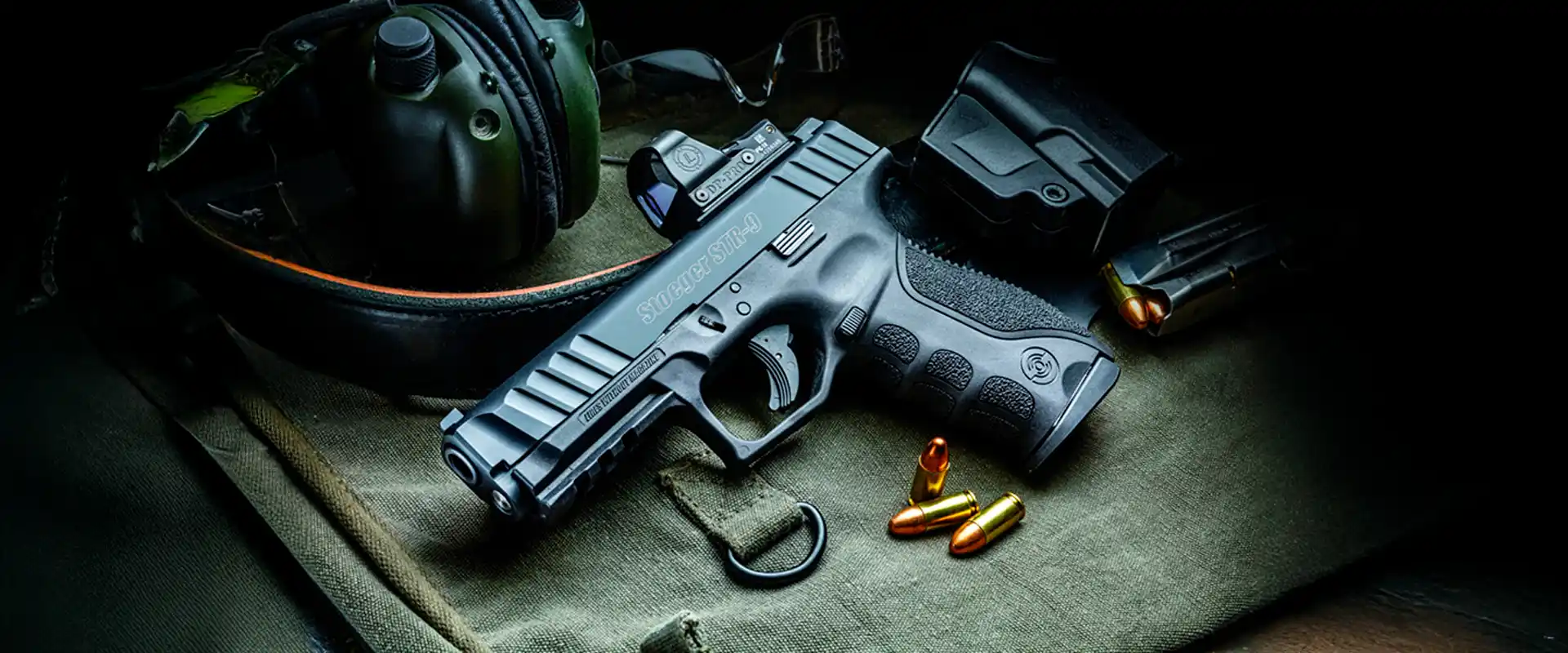
The world’s most popular handgun caliber. It delivers excellent balance between power, recoil, and cost, with a vast selection of firearms and ammunition types.
.40 S&W
A step up in power and recoil. While effective, it can be challenging for beginners to shoot comfortably or quickly.
.45 ACP
A legendary round known for its heavy impact and slow velocity. However, its strong recoil and limited magazine capacity make it better suited for experienced shooters.
Why 9 mm Is the Best Choice to Start With
The 9 mm Luger has become the global standard for good reason. It provides manageable recoil, solid accuracy, and high magazine capacity—an ideal mix for building shooting confidence.
Its affordability and widespread availability allow consistent practice, and the broad range of 9 mm pistols—from compact carry models to full-size competition guns—means you can grow within the same caliber as your skills improve.
Recoil Behavior and Firearm Control
One of the biggest challenges for beginners is learning to control recoil without losing sight alignment.
The .22 LR is nearly recoil-free, while the .380 ACP adds just enough movement to simulate real shooting conditions. The 9 mm sits perfectly between controllable and realistic, teaching proper grip and follow-through under true firing conditions.
Dry-fire drills and double-tap training are excellent ways to master recoil management before moving up in power.
Training Cost and Ammunition Availability
Training frequency is the key to progress. The 9 mm and .22 LR dominate this category thanks to their low cost per round and wide availability.
A new shooter firing 200 rounds per range session will quickly notice how much ammo pricing impacts consistency. Choosing an economical caliber allows for regular, high-volume practice, which is far more valuable than occasional sessions with a high-powered gun.
Evolving Gradually: How to Move Up in Caliber
The most effective progression for new shooters is to start with a .22 LR, master the basics, and then transition to 9 mm for more realistic performance.
Jumping directly into .40 S&W or .45 ACP can cause flinching, poor trigger control, and frustration. Skill development in shooting should always be gradual—master control first, then power.
The Caliber That Teaches Without Punishing
The best caliber for a beginner isn’t the most powerful—it’s the one that lets you build solid fundamentals in grip, sight alignment, breathing, and trigger control.
That’s why the 9 mm Parabellum remains the smartest, most versatile option. It combines mild recoil, consistent accuracy, low cost, and global availability.
Learning on 9 mm gives you a foundation strong enough to handle any other caliber confidently later on.