You didn’t buy a firearm thinking, I can’t wait to shop for a safe.
You bought it to protect yourself, your family, or your home.
The safe part? That usually comes later, often after a moment that makes you pause.
If you’re new to firearm ownership, gun safes can feel overwhelming fast.
Everyone online seems to be shouting about ratings and James Bond technology, so how can you know what you actually need?
Glad you asked
At Auction Armory, we’ve sat down and reviewed the real data, along with the myths that tend to confuse first-time gun owners.
We’ve seen where beginners overthink things, where they undershoot safety, and where bad advice keeps getting repeated online.
You don’t need the biggest safe on the market, and you don’t need a checklist built for collectors with 20 firearms.
What you do need is a clear understanding of what actually keeps people safe, what doesn’t, and how to store a firearm responsibly from day one.
Let’s begin…
Do Beginners Actually Need a Gun Safe?
It depends on your situation, but for most first-time gun owners, safe storage isn’t optional if you care about safety.
And everyone cares about that.
A gun safe becomes especially important if:
- You live with children, teens, or frequent visitors.
- Your home isn’t always under your control (roommates, shared spaces, rentals)
- You want to prevent curiosity-driven access, not just intentional misuse.
- You’re building good habits early, before shortcuts become normal.
Legally speaking, not every state requires a gun safe.
But responsibility doesn’t stop at the minimum legal requirement.
A locked, secure storage solution dramatically reduces the risk of accidents, unauthorized handling, and situations you never intended to deal with.
If you’re the only adult in the house, live alone, and your firearm is never left unattended, you might technically get by without a full-size safe.
But even then, most beginners find that a safe adds peace of mind.
What a Beginner’s Gun Safe Does
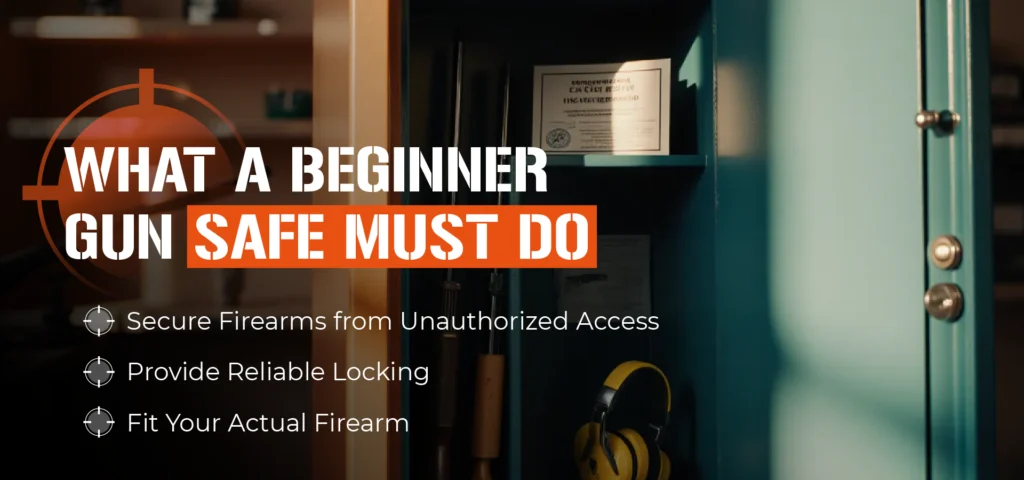
When you’re new to gun ownership, it’s easy to get distracted by features. Lights, apps, fire ratings, marketing buzzwords. But a beginner gun safe has a much simpler job. If it doesn’t do these things well, nothing else really matters.
Keep Your Firearm Out of the Wrong Hands
This is the baseline. A gun safe exists to prevent access by anyone who shouldn’t be handling a firearm, intentionally or accidentally.
That includes:
- Children and teens.
- Guests who don’t understand firearm safety.
- Anyone who might stumble on it out of curiosity.
Accidental access is one of the most common and preventable safety risks for new gun owners. A proper safe creates a physical barrier that removes chance from the equation. If someone can’t open it, they can’t mishandle it.
Simple as that.
Lock Reliably, Every Time
For beginners, reliability is non-negotiable.
You don’t need the most advanced locking system on the market.
You need one that works consistently, opens when you expect it to, and doesn’t encourage shortcuts.
Common beginner-friendly options include:
- Keyed locks: Simple, but only if the key is controlled.
- Electronic keypads: Fast and dependable when used correctly.
- Biometric locks: Convenient, but only if they’re proven and well-maintained.
The best lock is the one you’ll actually use every single time.
If it’s frustrating or unpredictable, you’ll be tempted to leave the safe unlocked, and that defeats the purpose.
Fits Your Actual Firearm
A common beginner mistake is buying a safe based on what you might own someday instead of what you own right now.
Your safe should:
- Properly fit your current firearm.
- Allow safe storage without forcing awkward positioning.
- Leave a little room for essentials, not excess.
Oversized safes often get placed in less secure locations simply because they’re harder to install or hide.
A well-sized safe that’s easy to place and secure is far safer than a massive one that ends up compromised.
Be Solid Enough to Deter Quick Access and Theft
You’re not planning for a movie-style break-in, well, not always, at least.
You’re planning to stop opportunistic access.
A beginner gun safe should:
- Use solid materials that resist prying.
- Be capable of being bolted down if needed.
- Hold up against quick, casual attempts to open it.
What Beginners Think They Need (But Usually Don’t)
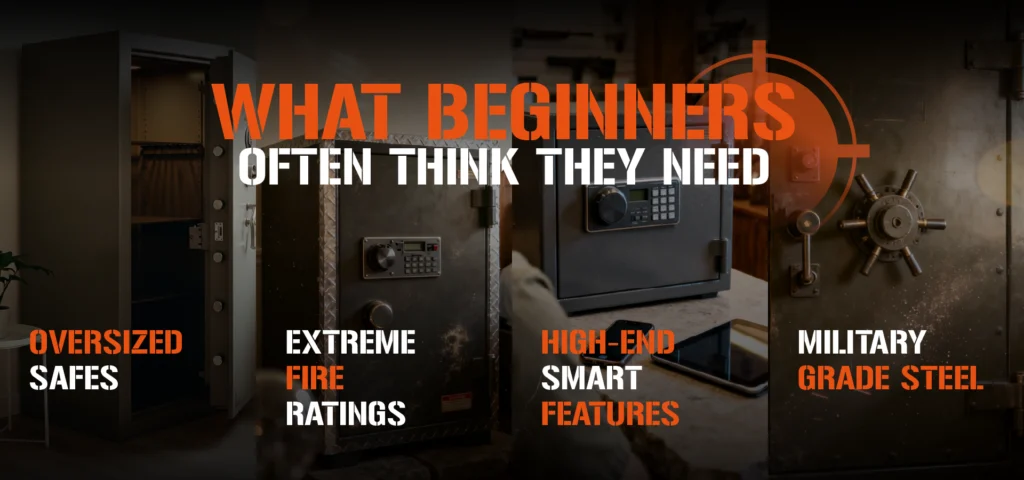
Oversized Gun Safes
Trust us on this
Sometimes, the bigger, the better, isn’t always the case.
Oversized safes often create new problems, including harder placement, less secure installation, and higher costs without added protection.
The majority of beginners only need space for what they currently own, not a future collection that may never materialize.
High Fire Ratings
Fire protection matters, but you’re often pushed toward ratings you’ll likely never need.
Higher fire ratings usually mean a bigger, heavier, more expensive safe, and for most homes, that extra bulk doesn’t actually make your day-to-day storage any safer.
Smart and App-Connected Features
Wi-Fi connectivity, mobile alerts, and app-controlled locks sound reassuring, but they also introduce failure points.
If you are new to this, simplicity and reliability usually provide more safety than the latest tech.
How to Properly Place a Gun Safe in Your Home
- Keep it out of sight
This is a simple one. Discreet placement, after all, helps reduce curiosity and theft risk. - Choose a space you control
Bedrooms, closets, or private storage areas work better than shared spaces. The fewer people who pass by your safe, the safer it is. - Avoid moisture and heat
Excess humidity and temperature changes can damage firearms over time. Garages and basements require added protection if you are planning to store your safe there. - Balance access with responsibility
You want access when you need it, but not at the expense of safety. Quick access should never mean easy access for others. - Secure the safe whenever possible
Bolting your safe down adds an important layer of protection, especially for smaller safes. A safe that stays put is far harder to misuse.
Habits for Safe Firearm Storage
A gun safe is useful and even necessary, but it doesn’t make decisions for you.
Safe storage depends on the habits you build and repeat, especially as a beginner.
Make Locking Automatic
- Locking the safe should be part of the same motion as putting the firearm away.
- Avoid “just for a minute” exceptions, which can slowly weaken good habits.
- When locking is automatic, safety doesn’t depend on memory or circumstances.
Be Deliberate About Who Has Access
- Anyone who knows the code or has a key effectively has access to your firearm.
- Share access only when absolutely necessary, and revisit it if your household changes.
- Treat access like responsibility, not convenience.
Don’t Rely on Assumptions
- Take a moment to confirm the safe is secured.
- Consider how curiosity or unfamiliarity can lead to unintended access.
- Simple checks remove unnecessary uncertainty.
Set Clear Expectations at Home
- Make it clear that the safe is off-limits and not a point of curiosity.
- Clear boundaries help reduce risk before it becomes a problem.
- Unspoken rules tend to fail when safety is involved.
Check In on Your Setup Regularly
- Batteries can die, and locks can wear over time.
- Quick periodic checks help catch small issues early.
- A few seconds of maintenance can prevent bigger problems later.
Beginner Gun Safe FAQs
When should I get a gun safe, before or after buying a firearm?
Ideally, before or at the same time.
Safe storage works best when it’s part of the plan from day one, not something added later once habits have already formed.
What if I only own one firearm?
Even a single firearm should be stored securely.
Beginners often assume safes are only for collections, but safe storage is about access control, not quantity.
Is it okay to leave a firearm unsecured if no one else is home?
Situations change quickly, guests stop by, routines shift, and assumptions break down.
Secure storage helps keep safety consistent, not conditional.
How do I balance quick access with safe storage?
The goal isn’t speed at all costs; it’s controlled access.
A storage setup should allow you access without making that access easy for anyone else.
What’s the biggest mistake beginners make with gun safes?
Thinking that the safe alone solves everything.
Gun safes work when equipment and habits work together, not when one replaces the other.
How do I know if my storage setup is “good enough”?
If your firearm is secured, access is controlled, and your habits are consistent, you’re doing the most important things right.
Safety improves through intention, not perfection.