You don’t usually think about firearm safety on a calm, ordinary day. It’s not when something goes wrong, it’s when nothing happens at all.
The firearm sits where you left it. Life moves on. And that’s exactly where secure storage is expected to do its job.
Most safety conversations around firearms focus on training and handling, and rightly so.
But what happens after the range trip, after cleaning, after the day is done?
That’s where gun locks should get the spotlight.
The idea is simple: A firearm that isn’t actively in use shouldn’t be accessible just because it’s familiar to you.
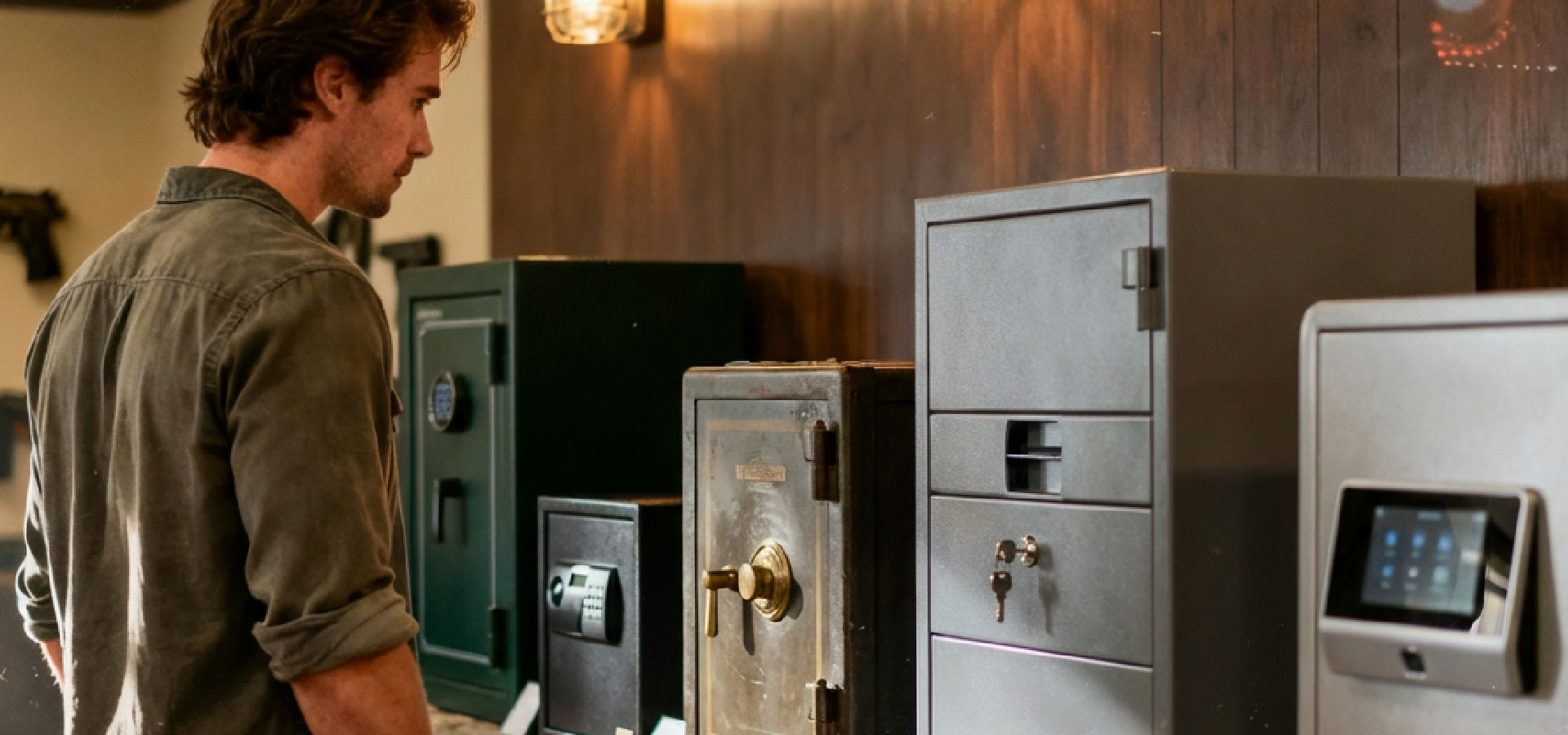
If you’ve ever stood in front of a display case or opened a drawer and paused, even for a second, wondering whether your storage setup is really doing enough, you’re not alone. Different locks exist because different risks exist.
Some prevent a trigger from moving. Others keep the action visibly open. Some are built into the firearm itself.
Understanding the types of gun locks is about knowing why each option exists, and how that knowledge can be a tremendous help if you want to store your firearms more securely, reduce unnecessary risk, and make informed decisions that actually fit your day-to-day life.
So…let’s begin.
Why Gun Locks Matter for Firearm Safety
There might be some exceptions out there, but most of the time, accidents involving firearms happen because something small was overlooked.
A moment of convenience. A change in routine. A firearm was left accessible longer than intended.
Gun locks exist for those moments.
When a firearm isn’t actively in use, the goal shifts from performance to prevention. Locks help reduce the risk of unauthorized access, whether that’s a curious child, a guest who doesn’t understand firearm boundaries, or someone who simply shouldn’t have access at all.
They also lower the risk of accidental discharge by physically interrupting the firing process or blocking the action entirely.
Gun locks help make sure that safety doesn’t disappear the moment the firearm is set down.
Trigger Locks
What a Trigger Lock Is
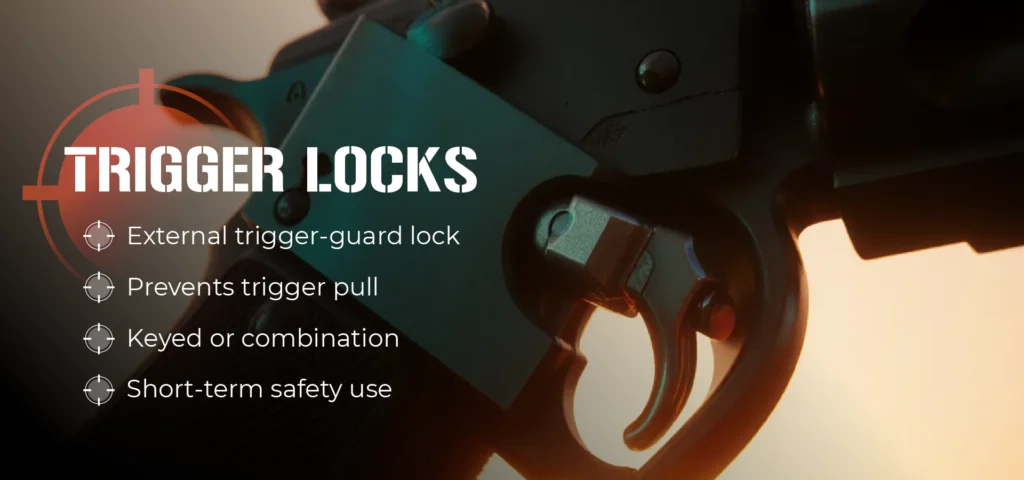
A trigger lock clamps around the trigger guard and does one very specific job: it keeps the trigger from being pulled. It’s often the first locking device you come across, not because it’s the most advanced, but because it’s simple and widely available.
- Fits externally around the trigger guard.
- Creates a physical block between the finger and the trigger.
- Designed to make firing the firearm impossible while installed.
How Trigger Locks Work
You install a trigger lock directly onto the firearm, usually using a key or a combination. There’s no need to take the firearm apart, which makes it easy to use, especially if you’re looking for a quick, visible safety step when the firearm isn’t in use.
- Keyed or combination locking mechanisms.
- Installed externally on the firearm.
- Does not interact with internal components.
Security Benefits
Trigger locks add a basic but intentional barrier against unauthorized handling. If someone doesn’t have the key or code, they can’t simply pull the trigger, and that interruption alone matters more than people often realize.
- Helps prevent casual or unintended handling.
- Often included with firearm purchases.
- Makes it immediately clear that the firearm is not ready to fire.
Limitations
This is where context matters. A trigger lock limits function, not access. The firearm can still be picked up or taken, and the chamber or action remains accessible depending on the design.
- Does not secure the firearm itself from being removed.
- Not compatible with all trigger guard designs.
- Does not block chamber access.
Best Use Case
Trigger locks make the most sense when you’re thinking short-term or layered safety. They’re not meant to do everything on their own, and that’s okay.
- Temporary storage situations.
- As an additional layer, when combined with locked containers.
- When visibility and ease of use are priorities.
Cable Locks
What a Cable Lock Is
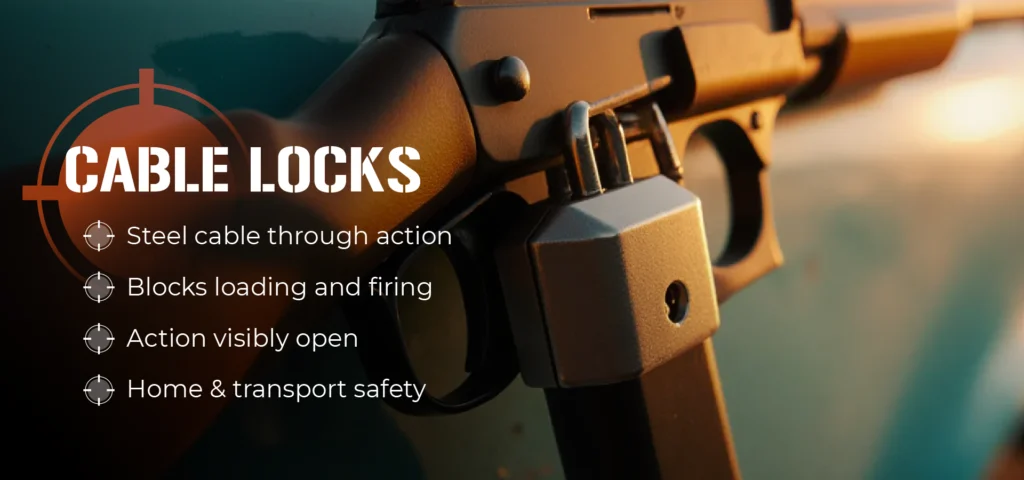
A cable lock uses a steel cable that runs through the action of the firearm, making it physically impossible to load or fire. If you’ve ever seen a firearm with the action held open and a bright cable running through it, that’s a cable lock doing its job.
- Steel cable threaded through the firearm
- Prevents the firearm from being loaded or fired
- Commonly used across handguns, rifles, and shotguns
How Cable Locks Work
The cable is inserted through the chamber or magazine well, depending on the firearm, and then secured with a key or combination. Once locked, the action cannot be closed, which is why cable locks are often favored for storage and transport.
- Passes through the chamber or action.
- Keeps the action visibly open.
- Uses keyed or combination locking mechanisms.
Security Benefits
Cable locks are effective because they interrupt the firearm at a critical point. You don’t just hope the firearm can’t fire; you can see that it can’t.
- Clear visual confirmation that the firearm is inoperable
- Works with many firearm types and sizes
- Helps reduce the risk of accidental loading or discharge
Limitations
Like trigger locks, cable locks focus on disabling the firearm rather than physically securing it. The strength of the lock also depends on the cable itself, which can vary in quality.
- Does not prevent the firearm from being taken.
- Cable thickness and durability vary by model.
- Requires proper placement to be fully effective.
Best Use Case
Cable locks are a solid choice when you want visible, straightforward safety without adding complexity.
- Home storage when firearms are not in active use
- Transporting firearms safely
- Situations where visibility and compliance matter
Chamber Locks
What a Chamber Lock Is
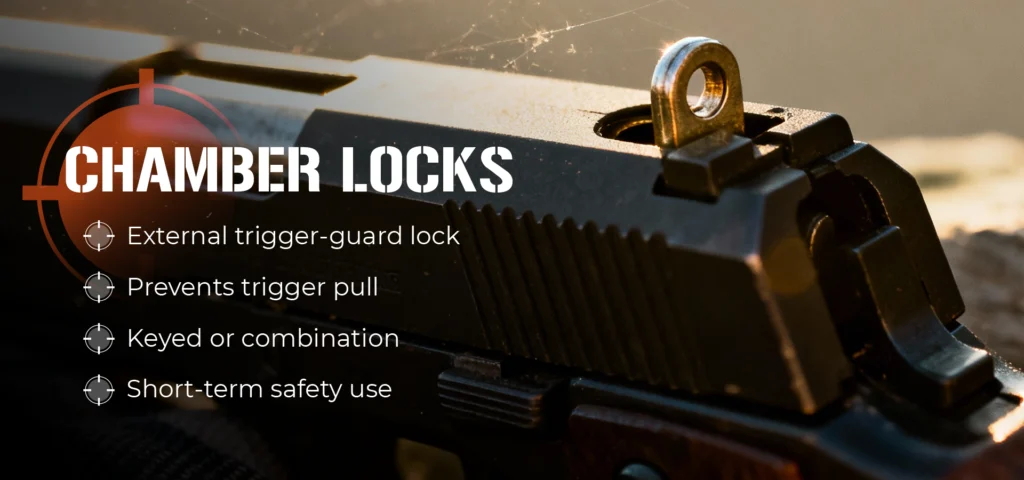
A chamber lock is designed to sit directly inside the firearm’s chamber, physically occupying the space where a round would normally be loaded. If the chamber is blocked, the firearm simply can’t be fired, and that’s the entire point.
- Inserts directly into the chamber
- Prevents a round from being chambered
- Creates a clear mechanical block
How Chamber Locks Work
Once inserted, the chamber lock stays in place using a keyed or mechanical locking system. Because it lives inside the chamber, it stops the firing process at the earliest possible step. This might feel like an upgrade if you compare it to the previous options.
- Installed directly in the chamber
- Prevents loading and chambering
- Typically secured with a key or tool
Security Benefits
Chamber locks are very literal in what they do. They don’t rely on external pressure or positioning; they block the firearm where firing begins.
- Ensures the firearm cannot be chambered
- Provides a clear, mechanical safety barrier
- Often used in controlled or display environments
Limitations
Chamber locks aren’t designed for every situation. While they prevent firing, they don’t restrict physical access to the firearm itself.
- Firearms can still be handled or removed
- Less common for everyday home storage
- Not compatible with all firearm types
Best Use Case
Chamber locks make the most sense when visibility and certainty matter more than convenience.
- Display firearms
- Educational or controlled settings
- Situations where preventing chambering is the primary goal
Magazine Locks
What a Magazine Lock Is
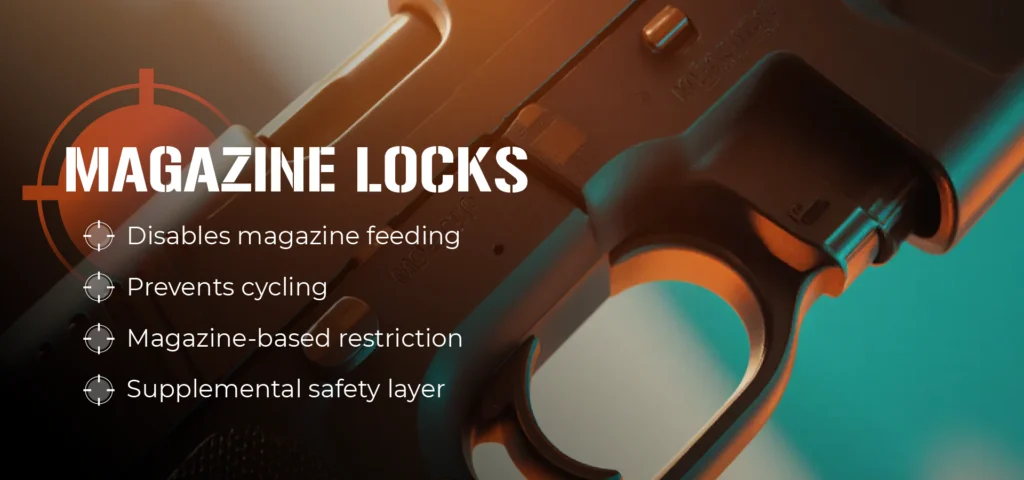
A magazine lock focuses on one specific part of the firearm: how ammunition is fed. Instead of blocking the trigger or the chamber, it limits or disables the magazine itself, which changes how, or if, the firearm can be loaded.
- Interferes with magazine insertion or removal
- Affects the firearm’s ability to feed ammunition
- Most commonly associated with magazine-fed firearms
How Magazine Locks Work
As the name hints, a magazine lock restricts the normal movement of the magazine. That means you can’t insert one, remove one, or cycle ammunition the way the firearm was designed to operate.
- Blocks or restricts the magazine function
- Prevents proper feeding and cycling
- Installed as a mechanical restriction
Security Benefits
Magazine locks are about control. By interrupting the feeding process, you reduce the chance of the firearm being loaded or used unintentionally.
- Limits the ability to load ammunition
- Reduces risk tied to magazine-fed operation
- Adds an extra layer of mechanical interruption
Limitations
This is where it’s important to be clear about what a magazine lock does and what it doesn’t do. It doesn’t secure the chamber, and it doesn’t prevent someone from handling or taking the firearm.
- Does not block chambered rounds
- The firearm itself remains accessible
- Not a standalone storage solution
Best Use Case
Magazine locks work best as a supporting measure, not the main line of defense.
- Supplemental safety layer.
- Specific compliance or regulatory environments.
- When combined with other storage or locking methods.
Integrated (Built-In) Firearm Locks
What an Integrated Lock Is
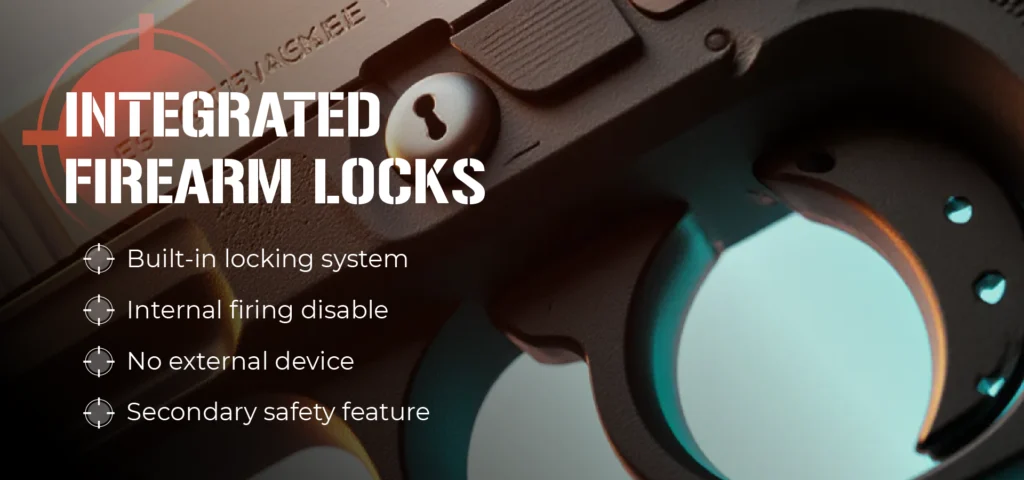
An integrated lock is built directly into the firearm by the manufacturer. Instead of adding an external device, the locking mechanism is already part of the firearm’s design, usually tucked away until you need it.
- Built into the firearm itself.
- Activated with a key or specialized tool.
- Designed to disable the firing mechanism.
How Integrated Locks Work
When engaged, the lock disables internal components that allow the firearm to fire. From the outside, the firearm may look unchanged, but internally, it’s no longer functional.
- Locks internal firing components.
- Prevents the firearm from operating normally.
- Does not require attaching or removing a separate device.
Security Benefits
Integrated locks are always there; you don’t have to remember where you put them or whether you installed them. That built-in presence can make safe storage feel more seamless.
- Permanently available on the firearm.
- No external lock to misplace.
- Maintains the firearm’s original form factor.
Limitations
Because these locks are manufacturer-specific, their design and effectiveness vary. They also focus on disabling function, not restricting physical access.
- Not standardized across all firearms.
- Firearms can still be handled or removed.
- May not meet all storage recommendations on their own.
Best Use Case
Integrated locks work best when you see them as a supporting feature, not the only safety measure in place.
- Secondary safety option.
- Owners who prefer minimal external accessories.
- Situations where simplicity matters.
Gun Locks vs. Gun Safes and Lockboxes
What Gun Locks Do
At this point, you probably know that gun locks are designed to disable a firearm so it can’t be fired.
They focus on stopping function, not controlling who can physically access the firearm.
What Gun Safes and Lockboxes Do
Safes and lockboxes restrict access by keeping firearms physically locked away. Their primary role is preventing unauthorized handling or removal.
Why Gun Locks and Safes Are Often Used Together
Using both creates a layered approach to firearm storage. One limits access, the other disables operation; together, they reduce risk more effectively than either alone.
Choosing the Right Storage Setup
The right choice depends on your household, your routine, and how often you access your firearms. Ultimately, you’ll make your mind based on your own security requirements and concerns.
How to Choose the Right Gun Lock
Start With the Type of Firearm You Own
Every firearm operates differently, and that matters more than people expect.
A lock that works well on a handgun may not make sense for a long gun, and certain designs simply won’t accommodate specific actions or trigger guards. Choosing a lock that matches how your firearm functions helps avoid gaps in safety or frustration that leads to inconsistent use.
Consider Who Else Has Access to Your Space
This is one of the most important factors.
Kids grow, routines change, and guests don’t always understand firearm boundaries. Even if access feels controlled today, thinking a step ahead helps you choose a lock that adds protection without relying on perfect circumstances.
Think About How Often You Access the Firearm
A firearm you access regularly needs a different approach than one stored long-term. The goal is to balance accessibility with security in a way that makes safe storage something you’ll actually maintain, not something you work around.
Match the Lock to the Storage Environment
Where the firearm lives matters. A lock used inside a safe plays a different role than one used in a drawer or case. Thinking about the environment helps you decide whether you need visibility, physical restriction, or an extra layer of mechanical safety.
Use Locks as Part of a Bigger Safety Plan
Gun locks work best when they support responsible ownership, not replace it. Training, awareness, and consistent storage habits all matter just as much as the device itself.
Frequently Asked Questions About Gun Locks
What is the safest type of gun lock?
There isn’t a single safest option for every situation. Different gun locks solve different problems. Cable locks and chamber locks physically block the firearm from being loaded, while trigger locks prevent the trigger from being pulled. The safest option is the one that fits your firearm, your storage environment, and those who have access to your space.
Are gun locks required by law?
In some jurisdictions, yes, particularly at the point of sale. Requirements vary by location, so it’s important to understand the laws where you live. Even where gun locks aren’t legally required, they’re widely recommended as part of responsible firearm storage.
Do cable locks work on all firearms?
Cable locks are among the most versatile options and work with many handguns, rifles, and shotguns. That said, not every cable lock fits every firearm design, so proper placement and compatibility still matter.
Can a gun lock prevent theft?
Gun locks are designed to disable a firearm, not physically secure it. While they can reduce the risk of unauthorized use, they don’t stop someone from taking the firearm itself. For theft prevention, locks are most effective when combined with safes or lockboxes.
Should gun locks be used with a safe?
In many cases, yes. Using a gun lock inside a safe or lockbox adds an extra layer of protection. If one layer fails or is bypassed, the other is still doing its job, which reduces overall risk.