Want to know what’s hot right now in any industry?
Words
Well, not just words, stories.
Because buyers don’t really remember specs.
They remember confidence. They remember clarity. They remember the seller who made them feel like they understood what they were buying before they ever asked a question.
And in a regulated industry like firearms, that matters even more. A listing isn’t just marketing, it’s reassurance. It answers the questions every buyer has: Is this legal for me? Is this safe? Is this seller honest? Am I about to make a mistake?
So does that mean you need to force yourself to become the next Dickens?
Not even close.
You don’t need literary talent. You need structured transparency. The best firearm listings aren’t written like novels; they’re written like guided experiences.
They anticipate concerns, remove uncertainty, and replace hype with useful detail.
In other words, the goal isn’t to impress the buyer.
It’s to help them decide.
This is how you do it
What Buyers Actually Look For Before Contacting a Seller
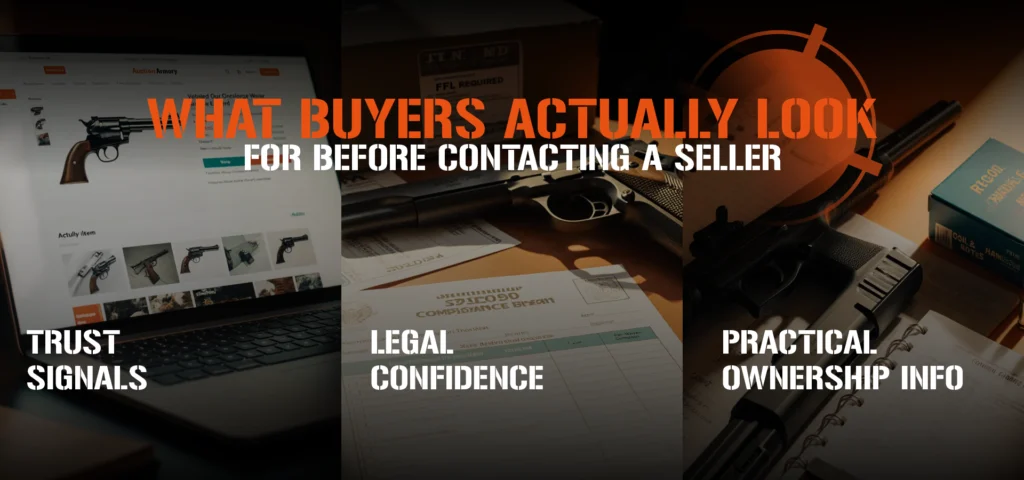
Before a buyer asks you a single question, they’re already deciding whether they want to ask you one.
Especially first-time buyers. And even more so, remote buyers.
Messaging a seller isn’t something random; it’s proof of a small commitment. If they feel confusion, they delay. If they feel risk, they leave. If they feel clarity, they proceed.
So they scan. Not read. Scan.
Their goal?
Feeling sure they can trust you.
Trust Signals
See? Trust matters.
Nobody’s going to deny AI has made life easier, but it’s also made buyers sharper. They’ve read a hundred listings that sound identical.
They stop believing at first read
They start looking for evidence.
Clear condition grading tells them you actually inspected it. Honest wear disclosure tells them you’re not managing expectations after the sale. Matching serial ranges (when appropriate) tells collectors you pay attention to details that matter to them.
And real, non-stock photos tell them it’s a real firearm, in your possession, exactly as shown.
Legal Confidence
This is where hesitation usually lives.
Not because the buyer doesn’t want the firearm, but because they don’t want a paperwork surprise halfway through the process. If they have to message you just to figure out whether the transfer is even possible, many simply won’t.
Clarity is something you can’t ignore here.
A few lines can remove most of the doubt:
- State compliance notes (so they don’t have to research mid-checkout)
- Transfer requirements and who initiates the FFL contact.
- Magazine or configuration restrictions upfront.
- How shipping is handled and what the buyer needs to provide.
Practical Ownership Info
Once legality feels safe, the buyer starts picturing ownership.
They’re wondering if it fits their use, not whether it exists on a spec sheet. Short, practical context does more work than a paragraph of features:
- What it actually feels like to shoot?
- Intended use (range, carry, collection, competition, hunting, etc.)
- Ammo availability or pickiness.
- Ease of maintenance and parts compatibility.
By crafting the right listing, you’re helping them imagine living with it,not just buying it.
The Anatomy of a High-Converting Firearm Listing
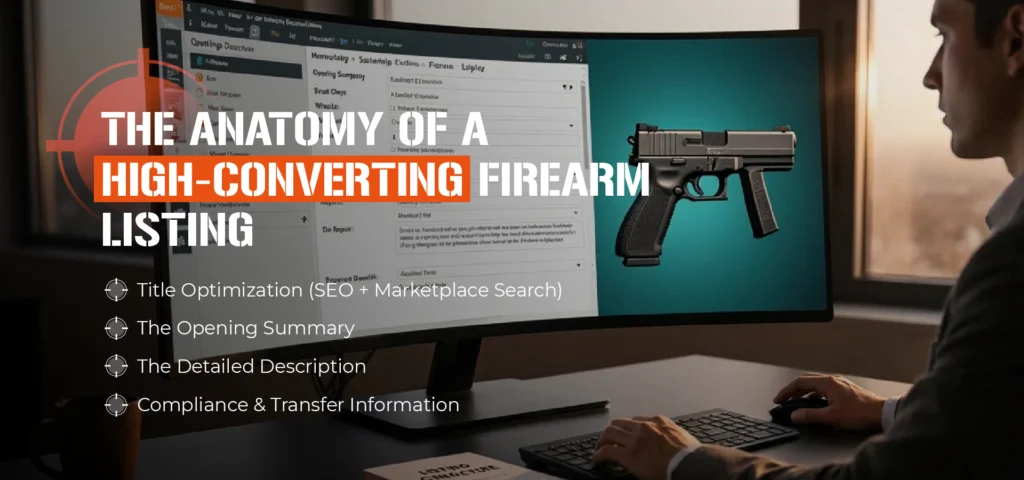
This is the part where we actually make the most of the product.
Good intentions help. Nice details help. But none of that matters if the listing isn’t working with the way buyers read.
So are you sure your listings are even being seen?
If you’ve ever had a solid firearm sit with views but no messages, chances are the issue isn’t the item. It’s the structure.
So instead of rewriting endlessly, let’s go over what makes a listing easy to understand at a glance,and easy to trust after a minute.
1. Title Optimization (SEO + Marketplace Search)
SEO crash course lesson 1: You need to be visible in search engines.
It doesn’t matter how amazing your product is, if users cannot find it, it doesn’ exist.
Not because the firearm isn’t desirable, but because the title is vague, incomplete, or trying too hard.
Marketplace search is literal. Buyers type exactly what they want. If your title doesn’t match that language, you’re depending on luck.
At minimum, your title should clearly include:
- Brand
- Model
- Caliber
- Variant or generation
A clean, structured title tells both the platform and the buyer: This is exactly what you searched for.
And that alignment alone increases clicks.
2. The Opening Summary
Ever heard that first impressions are hard to forget?
Well, yes…
Now that you have grabbed someone’s attention, you need to make sure that they stay with the product long enough to make a decision.
In a few sentences, the buyer should understand:
- What it is?
- Who it suits?
- Why it’s appealing?
- What condition it’s truly in?
Think of this as setting expectations early. If it’s been lightly used, say so. If it’s a range-focused setup, clarify that. If it’s collectible, signal why.
Buyers relax when they feel oriented.
A clear summary reduces the urge to scroll nervously looking for missing context. It tells them they’re dealing with someone who understands what matters.
3.The Detailed Description
This is where good listings separate themselves from recycled ones.
You don’t need to write a novel, you need to write with honesty and full clarity.
Instead of one dense paragraph, break it into logical sections. That alone improves readability and confidence.
Mechanical Condition
Buyers want reassurance that what they’re buying performs as expected. Address things like:
- Bore condition.
- How the action cycles.
- Trigger feel.
- Any modifications or replaced parts.
Cosmetic Condition
Make sure you are transparent about the appearance of your product:
- Finish wear and where it appears.
- Visible scratches or handling marks.
- Grip condition.
- Photos that correspond to what you’re describing.
Included Items
Never assume.
If it’s not listed, many buyers assume it’s not included,and hesitation shows up.
Clarify things like:
- Original box.
- Number of magazines.
- Optics plates.
- Aftermarket upgrades.
- Manuals or paperwork.
4. Compliance and Transfer Information
Clarify that the firearm ships to an FFL, whether local pickup is possible, and if there are any state restrictions they should know before reaching out. Briefly note the age and ID requirements and mention a waiting period if one applies.
That small bit of structure turns uncertainty into predictability.
And predictability is powerful.
Writing Descriptions That Educate.
| If You Write This… | Try Writing This Instead… |
|---|---|
| Shoots great | Approximately 200 rounds fired with no malfunctions |
| Like new | 98% finish, minimal slide wear near the muzzle |
| Very accurate | Consistent 2” groups at 15 yards using 124gr FMJ |
| Excellent condition | Clean bore, strong rifling, minor cosmetic wear on grip |
| Upgraded trigger | Aftermarket trigger installed; smoother pull with clean break |
| Comes with extras | Includes original box, 3 magazines, and factory optics plates |
The Importance of Personality
Firearms are serious business.
That doesn’t mean your product descriptions should sound like Morse code.
Of course, you want to be respectful and follow all the rules, but once that technical side is done, there’s no reason why you should hide your brand’s voice.
Going back to what we opened this article with: stories are what drive attention right now.
People are craving that sort of context that makes the listing feel anchored in reality.
A brief note on its use, followed by a side paragraph on what makes it special.
A small amount of personality turns specifications into a scenario they can picture themselves in.
A High-Converting Listing Template
You don’t have to reinvent this every time.
In fact, most inconsistent listings happen because sellers start from a blank page. A simple structure removes that friction; you just fill in the specifics, and the listing stays clear by default.
The best part?
This has been created by someone who writes for a living and knows how to get things out there.
| Section | What to Include | Tips |
|---|---|---|
| Title | Brand, model, caliber, variant, key feature | Keep it factual. Personality here comes from precision, not creativity. A clean title feels professional. |
| Overview | What it is, who it suits, why it’s desirable, honest condition summary | Write like you are orienting someone, not pitching them. One calm sentence often works better than three excited ones. |
| Mechanical Condition | Bore condition, action function, trigger feel, round estimate, modifications | Replace adjectives with observations grounded in real life. This is what makes the best stories. |
| Cosmetic Condition | Finish wear, marks, grip condition, notes matching photos | Mention imperfections casually and directly. Confidence in disclosure reads as honesty. |
| Included Items | Box or case, number of magazines, plates, accessories, paperwork | Avoid surprises. Buyers relax when they know exactly what arrives in the package. |
| Transfer & Shipping | Ships to FFL, local pickup (City/Region), restrictions, requirements, waiting period | Write this like instructions, not warnings. Calm process explanations reduce hesitation. |
| Payment | Accepted methods, payment timeframe, when transfer or shipment begins | Predictability builds trust. Short and clear beats detailed and complicated. |
| Disclaimers | Compliance responsibility, confirm legality, questions before committing | Keep it respectful and practical, informative rather than intimidating. |
FAQs
Do I need to include transfer information in every listing?
Yes, or at least enough to remove uncertainty. Buyers often hesitate not because they don’t want the firearm, but because they don’t understand the process. A short explanation prevents unnecessary back-and-forth and filters out incompatible buyers early.
Should I list cosmetic flaws even if they’re minor?
You should, especially if they’re minor. Small, clearly disclosed wear builds credibility and prevents bigger problems later. Most buyers accept honest imperfections far more easily than unexpected ones.
Is it okay to use manufacturer specifications in my description?
They help, but they shouldn’t be the entire listing. Specs tell the buyer what the firearm is. Your notes tell them what this specific one is like. Both matter, but only one builds trust.
Why aren’t people messaging me even though I’m getting views?
Most of the time, it’s hesitation, not disinterest. Missing transfer details, unclear condition, or vague wording force the buyer to do extra work, and many simply move on to a listing that feels easier to understand.Do longer descriptions perform better?
Clearer descriptions perform better. A well-structured listing can be longer and still feel easier to read than a short paragraph with missing details. Organization beats brevity.