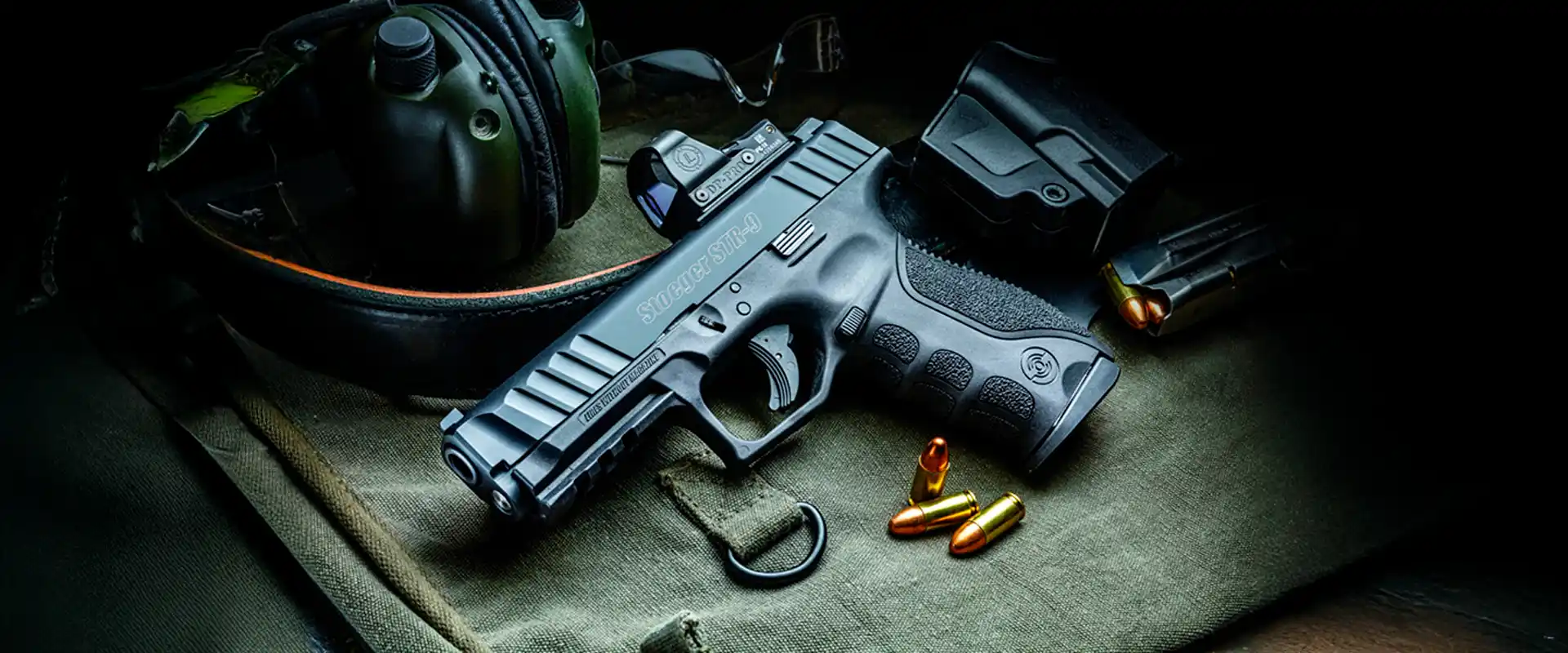
Temperature, humidity, altitude, dust, and sunlight aren’t just weather conditions, they’re active forces that act on your firearm every time you step into the field, secure your home, or store your collection. Understanding them is the difference between a precise, reliable shot and a failure at the worst possible moment.
Every seasoned shooter knows that even the finest equipment can fail if you don’t understand the environment it operates in. Firearms are high-precision mechanical systems, and like any such system, they respond directly and predictably to changes in their surroundings. At Auction Armory, we believe true mastery isn’t just about choosing the right weapon, it’s about knowing how the world around you affects it, every day, in every condition.
Whether you’re a hunter tracking game in the Andean highlands, a homeowner maintaining a firearm for personal protection in a coastal city, or a passionate collector preserving historically significant pieces, this article is written for you. We’ll break down each environmental variable, its real-world effects and the concrete solutions for every user profile.
FACTOR 01 — THE MOST UNDERRATED
Temperature: The Physics That Rewrites Your Ballistics
Temperature is arguably the most underestimated environmental factor by novice shooters and the most respected by professionals. Its effects ripple through every layer of your firearm system: from the propellant powder to the lubricants, from the barrel metal to the stock materials.
Extreme Heat and Powder Burn Rate
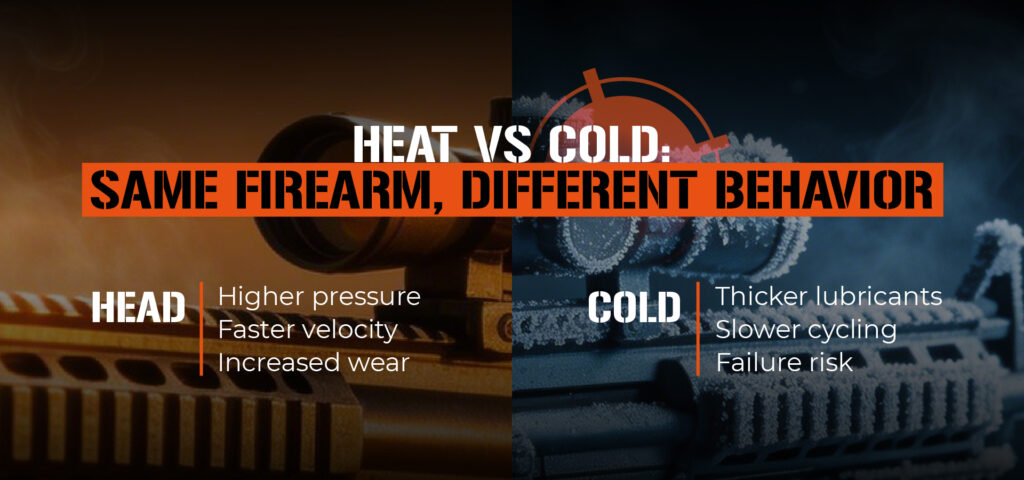
When temperatures exceed 95°F (35°C), conventional lubricants thin out or evaporate, dramatically reducing protection on moving parts. This creates excess friction in the bolt mechanism, which can cause feeding or extraction failures. But the most critical effect is on the powder charge: elevated temperatures accelerate the propellant’s burn rate, raise chamber pressure, and increase muzzle velocity. The practical consequence? Your previously established ballistic data is no longer valid. A shot perfectly zeroed in mild conditions can impact several inches higher on a sweltering summer day.
30+ fps Velocity variation per 10°C (18°F) temperature change | -40°F Minimum tolerance for professional-grade cold-weather lubricants | 3× Increased mechanical wear without proper lubrication in extreme conditions |
Freezing Temperatures: When Oil Becomes the Enemy
At the other extreme, sub-zero temperatures present an equally serious set of challenges. Thick lubricants solidify and lock up firing mechanisms, there are documented cases of perfectly maintained firearms failing completely at -20°F because the oil turned into a paste that blocked the striker’s travel. Recoil springs lose elasticity in the cold, affecting the reliability of the firing cycle. For winter operations, the golden rule is to use lubricants specifically formulated for low temperatures and apply as little as possible, in the cold, less is definitively more.
Powder doesn’t read the manual. It reads the temperature. A 20°F swing can change muzzle velocity by 30+ fps, throwing your entire calculated point of impact out the window.
FACTOR 02 — THE SILENT OXIDIZER
Humidity and Rain: Corrosion, Failure, and Lost Accuracy
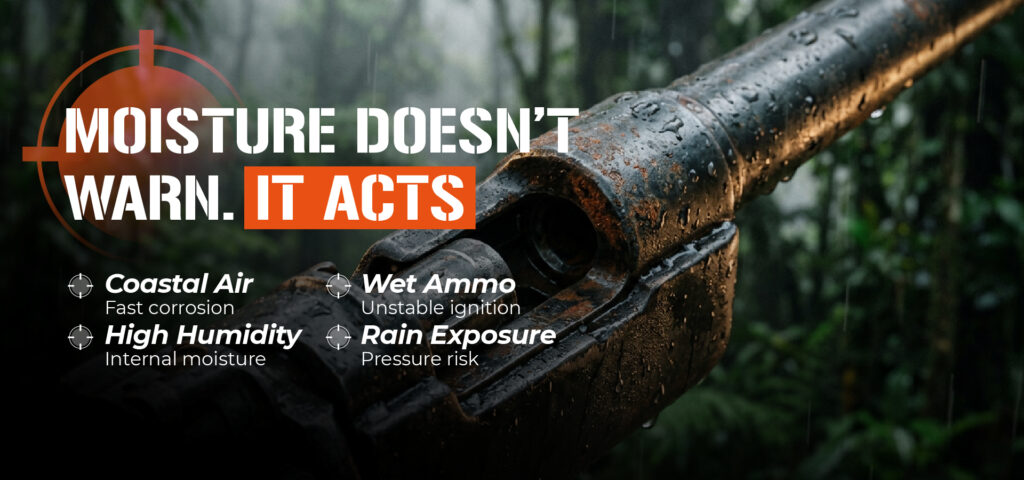
Humidity is the leading cause of corrosion in firearms, and its effects range from cosmetic damage to complete mechanical failure. A firearm exposed to humid environments without proper maintenance can develop active rust within hours in coastal settings, where salt-laden air attacks ferrous metals aggressively and relentlessly.
Hygroscopic Powder: The Risk Nobody Talks About
There’s a critical and rarely discussed aspect: gunpowder is hygroscopic, it actively absorbs moisture from the surrounding air. Once the powder absorbs moisture, its burn rate becomes inconsistent, and in extreme cases it may not ignite at all. For collectors who store ammunition long-term, this is especially relevant: old ammo stored in humid spaces can be not just inaccurate, but genuinely dangerous if moisture penetrated the charge unevenly.
Direct Rain Exposure: An Underestimated Danger
Water that enters the chamber can cause a sudden pressure spike if the projectile begins moving with water ahead of it. For field shooters, using waterproof covers and firearms with hydrophobic coatings or Cerakote finishes isn’t a luxury, it’s a basic safety measure. Running a dry patch through the bore before firing in rainy conditions is a habit that can prevent a catastrophic incident.
COASTAL / SALT AIR Salt air oxidizes steel in hours. Weekly maintenance minimum. Stainless steel or Cerakote strongly recommended. | JUNGLE / TROPICS Constant 80%+ humidity. Internal condensation common. Inspect bore and chamber before every use. | DIRECT RAIN Water in the chamber is dangerous. Waterproof covers and hydrophobic finishes are field essentials. | SNOW / THAW Snowmelt generates accelerated internal corrosion. Full inspection after every winter session. |
FACTOR 03 — PHYSICS THAT REWRITES YOUR DATA
Altitude: When Thin Air Changes Everything
Altitude is the factor that flatland shooters ignore until they face a miss at 11,500 feet above sea level. At higher elevations, atmospheric pressure drops, air becomes less dense, and this has direct and measurable consequences for every projectile fired.
Less Resistance, More Range, Different Data
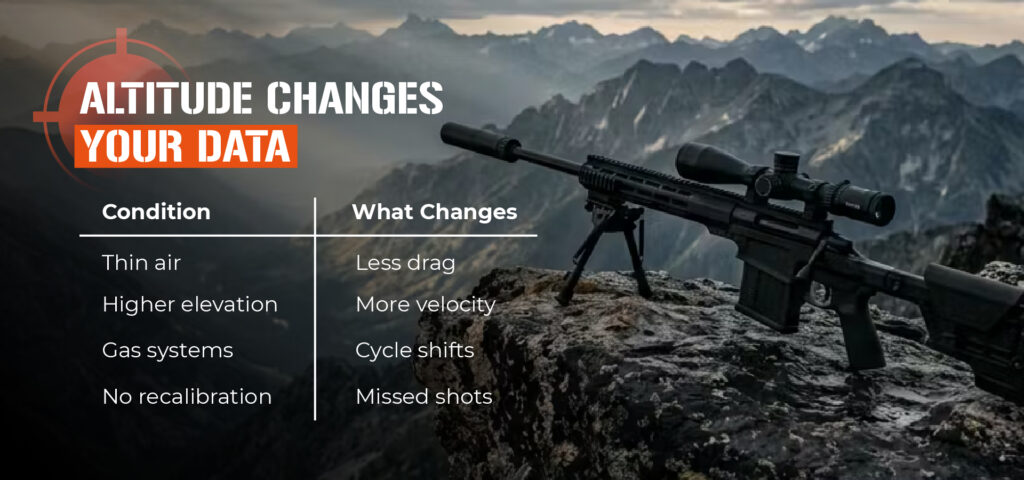
At 13,000 feet, a bullet faces significantly less aerodynamic drag. It travels farther and maintains higher velocity, completely altering the calculations for range, bullet drop, and wind drift. For a precision shooter, this can mean impacts that deviate several inches from sea-level data, unacceptable errors in big-game hunting or competitive shooting. Mountain hunters in ranges like the Rockies or the Andes must recalibrate their optics or compensate manually for every expedition at a new elevation.
The Effect on Gas-Operated Firearms
Semi-automatic and automatic firearms running on gas systems face an additional challenge at altitude. Combustion gases expand differently in thinner air, altering the firing cycle. A rifle perfectly tuned at sea level can become over-gassed at high altitude, producing more violent recoil, accelerated parts wear, and in extreme cases, damage to the bolt system. If your rifle has an adjustable gas regulator, calibrating it before each high-altitude session is non-negotiable.
AUCTION ARMORY TECHNICAL TIP
Modern ballistic apps like Hornady 4DOF and Applied Ballistics allow you to input altitude and barometric pressure to calculate precise corrections. In high-mountain terrain, never leave camp without updated data loaded into your device.
FACTOR 04 — THE INVISIBLE ABRASIVE
Dust and Sand: The Wear You Don’t See Until It’s Too Late
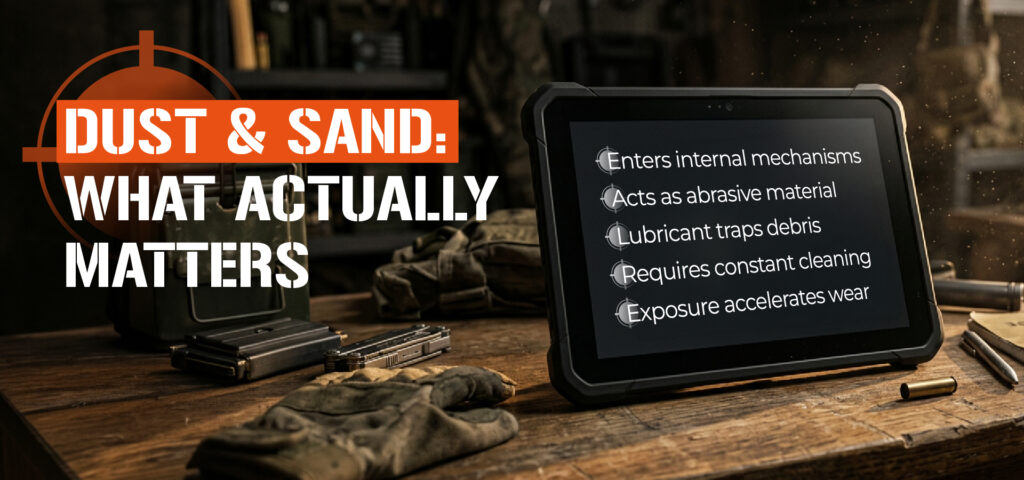
If you’ve ever operated a firearm in a desert environment or open field with a steady wind, you already know what we’re talking about. Dust and sand are natural abrasives that infiltrate the finest mechanisms and act like sandpaper on precision metal surfaces. A single grain of sand trapped between the bolt carrier and the receiver can score treated surfaces and create irregularities that compromise the firing cycle indefinitely.
The solution is not more lubricant, it’s the opposite. In dusty environments, excess lubricant acts as a magnet for particulates, creating an abrasive paste that actively damages the mechanism. The key is minimal lubrication with products formulated for arid conditions, keeping the firearm covered when not in active use, and cleaning it before shooting, not just after.
In the desert, the cleanest gun wins. Excess lubricant is your enemy when dust is in the air.
TAILORED GUIDE BY USER PROFILE
What You Need to Know Based on How You Use Your Firearm
Not every shooter faces the same environment or carries the same risks. Here are specific considerations for each type of firearms user:
| For the Hunter |
| Fields, mountains, jungles, shifting weather. Your firearm is a working tool that must perform on the first shot, every time.Hunters face the highest environmental variability of any shooter profile. A single day can begin in cold pre-dawn darkness and end under blazing afternoon sun, crossing rivers, climbing ridges, and shooting in rain or snow in between. There are no second chances when the animal is in front of you.Temperature swings throughout the day directly affect your point of impact. A rifle zeroed in cold morning air can print several inches high as the barrel heats up during the approach. For hunts at elevation, recalibrating before departure is mandatory, ballistic variables shift completely above 8,000 feet.Wooden stocks on traditional bolt-action rifles are especially vulnerable to humidity. Moisture causes wood to expand and then contract as conditions change, affecting the bedding, the precise fit between the action and the stock, and progressively degrading accuracy in ways that are subtle and hard to diagnose. Synthetic and fiberglass stocks eliminate this problem entirely and are the smart choice for hunters operating in high-humidity or variable-climate environments. |
| [ High-temp lubricant ] [ Recalibrate at altitude ] [ Synthetic stocks ] [ Waterproof cover ] [ Updated ballistic app ] |
| For Home Defense |
| Your firearm waits. When you need it, it must be perfect. The storage environment is everything. The home defense profile presents a unique challenge: the firearm may go weeks, months, or even years without being fired, and when the critical moment arrives, it must function without a single failure. This means the storage environment is absolutely decisive. Coastal areas carry the highest risk: salt air penetrates even poorly sealed gun safes and can corrode the firing mechanism within weeks. A home defense firearm stored in these conditions without regular maintenance can fail at the most critical possible moment. Minimum monthly inspection and cleaning is not paranoia, it is basic responsibility. Temperature extremes within the home also matter. Uninsulated garages can swing from -5°F in winter to over 120°F in summer. These swings cause condensation inside the chamber and can degrade stored ammunition. The ideal is a climate-controlled interior space with active humidity management. A gun safe with a built-in dehumidifier is an investment that pays for itself in reliability and peace of mind. |
| [ 40–55% humidity stable ] [ Interior, temp-controlled storage ] [ Monthly inspection minimum ] [ Dehumidifier in the safe ] [ Ammo in sealed containers ] |
| For the Collector |
| Historical pieces, century-old metals, unique woodwork. Preservation is as important as appreciation. For collectors, the storage environment determines not only whether the firearm functions, but its historical, aesthetic, and monetary value. A collection piece deteriorated by improper conditions can lose 30% to 70% of its market value, depending on the type and severity of the damage. Historic firearms with original finishes, engraving, or fine wood stocks are especially sensitive. Wood responds directly to humidity, it swells as it absorbs moisture and cracks as it dries out. A storage environment with relative humidity outside the 45%–55% range can irreversibly damage an original stock within a few seasons. Linseed oil and firearm-specific wood waxes help stabilize this process significantly. Metals with original patina, case-hardened finishes, or vintage nickel plating should be protected with neutral conservation oils such as Renaissance Wax or Ballistol, which preserve original surfaces without leaving active residues. Direct UV exposure is another silent enemy that fades colors and degrades surfaces on pieces displayed in open cases. UV-filtering glass is a worthwhile investment for any display cabinet. |
| [ 45–55% constant humidity ] [ No direct UV light ] [ Renaissance Wax or Ballistol ] [ Stable 60–70°F storage temp ] [ Annual photo inventory ] |
PRACTICAL PROTOCOL
Maintenance Checklist by Environment
Before heading out or after every use in adverse conditions, run through this protocol adapted to your specific environment:
- Extreme heat: use high-temperature lubricant, apply sparingly, verify point of impact after extended sessions.
- Sub-zero cold: use low-temperature lubricant, minimize total lubrication, store firearm indoors before deployment.
- Humid or rainy conditions: dry completely before storage, apply thin-layer corrosion inhibitor, inspect bore and chamber.
- Coastal / salt-air environment: weekly maintenance minimum, favor stainless steel or Cerakote finishes, check all part junctions.
- Dusty or sandy terrain: minimal lubrication, cover when not in active use, clean before shooting and after.
- High altitude: recalibrate point of impact, adjust gas regulator if applicable, update ballistic app with local data.
- Home storage: maintain 40–55% humidity, stable interior temperature, active dehumidifier, monthly inspection.
- Collection pieces: no direct UV, neutral conservation oils, controlled environment, annual photographic inventory.
Conclusion
The Environment Is Not an Excuse. It’s Your Responsibility.
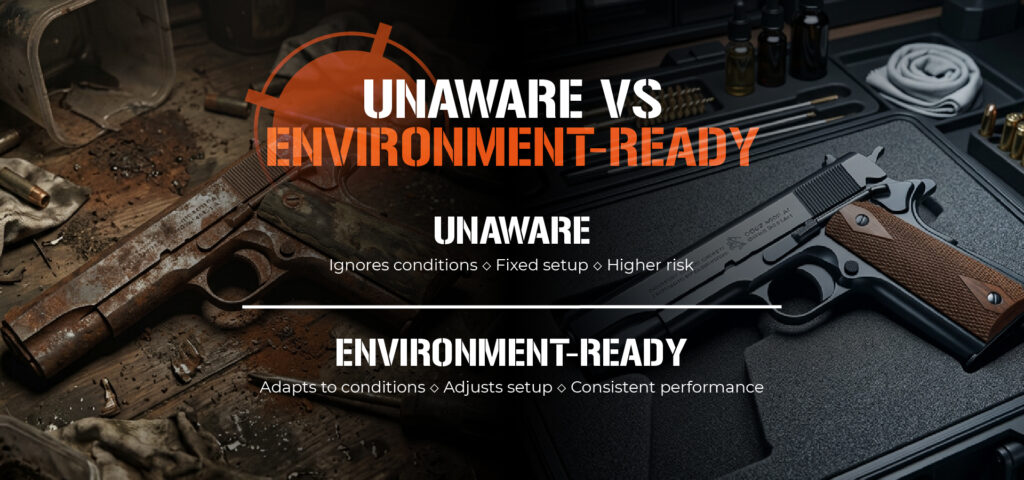
There’s a truth that separates average shooters from genuinely skilled ones: the environment always wins if you ignore it.
It doesn’t matter the caliber, the brand, the price tag, or the provenance of your firearm. If you don’t understand how climate acts on it, how terrain wears it down, and how storage degrades it, you’re losing precision, reliability, and value with every single day that passes.
The hunter who doesn’t recalibrate for altitude misses the shot of a lifetime. The homeowner who stores their defensive firearm in a damp garage discovers it failed exactly when they needed it most. The collector who displays pieces under direct sunlight watches decades of searching and investment slowly fade away.
But the other side of that coin is equally powerful: the shooter who understands the environment has a real, measurable advantage. They shoot with greater consistency, trust their equipment in adverse conditions, and preserve the value of their investment over time. Environmental awareness isn’t a minor technical detail. It’s a core part of mastery, regardless of your profile.
At Auction Armory, our mission is exactly that: to help you make informed decisions about what firearm to choose, how to maintain it, and how to get peak performance from it in any condition you face. Because the best firearm isn’t the most expensive one on the market. It’s the one you understand best.
| Your Next Piece Is Waiting At Auction Armory, we offer a curated selection of firearms, accessories, and parts built for every condition. Expert advisors available for every buyer profile. |
| EXPLORE AUCTION ARMORY | auctionarmory.com |
#FirearmMaintenance #GunPerformance #AuctionArmory #HunterTips #HomeDefense #GunCollecting #SportShooting #BallisticsEnvironment #ClimateAndGuns #FirearmStorage #GunCare #ResponsibleHunting #PrecisionShooting #GunMaintenance #outdoors