Safe rooms, you’d believe they’re something pulled straight out of an action movie: hidden doors, steel walls, dramatic lockdown scenes.
But in reality, a safe room is far less cinematic and far more practical.
If you own firearms, safety isn’t an abstract idea. It’s a daily responsibility that starts long before anything goes wrong.
A safe room is simply a controlled, secure space designed to prevent unauthorized access, protect your firearms from damage, and give you confidence that your storage is handled properly.
At Auction Armory, we’ve put together this guide to break down what a safe room actually is, how it differs from a standard gun safe, and what matters most when you design one responsibly.
But first, let’s start with the basics…
What Is a Safe Room?
If you think about a safe room and your mind immediately goes to Jodie Foster in Panic Room, you’re not alone.
That movie defined how most people imagine safe rooms, sealed doors, surveillance screens, and a high-stakes situation unfolding behind reinforced walls.
But that version is only a small part of the picture.
In real life, a safe room is mostly focused on control, planning, and prevention.
For firearm owners, a safe room is a secure, purpose-built space designed to limit access, protect firearms from damage, and reduce risk long before anything goes wrong.
There’s no drama. Just structure, intention, and systems that work quietly in the background. And unlike the movies, the goal isn’t reaction; it’s making sure you never have to react in the first place.
Safe Room vs. Panic Room: What’s the Difference?
A panic room is something you’d use for a very specific moment, when an immediate threat is already happening, and you need a place to retreat.
It’s reactive by design.
A panic room exists to buy time during an emergency, protecting the people inside until help arrives or the situation de-escalates.
A safe room is broader in purpose. It’s proactive. Instead of responding to danger, it’s designed to prevent it by controlling access, securing firearms properly, and protecting the people and valuables that matter to you.
Firearms may be part of the equation, but they’re not the only consideration.
Whether it’s limiting unauthorized access, safeguarding important items, or creating an added layer of protection for your household, a safe room becomes part of your safety on a daily basis.
Why Safe Rooms Matter for Firearm Owners
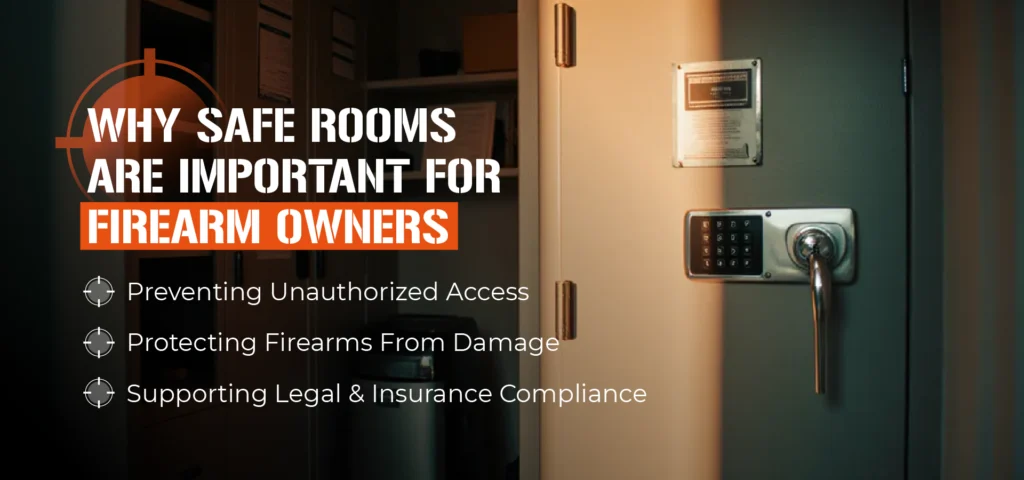
As we have just seen, a safe room isn’t just about firearms, but if you own them, it becomes one of the smartest ways to manage safety responsibly.
Firearms introduce a higher standard of care.
Not because they’re dangerous on their own, but because access, environment, and accountability matter more. A safe room helps you meet that standard.
Preventing Unauthorized Access
Most firearm-related incidents don’t involve strangers; they involve access that shouldn’t have happened in the first place.
A safe room creates a clear boundary. Children can’t wander in. Guests don’t have access. Opportunistic theft becomes far more difficult.
Access is intentional, controlled, and limited.
This is how you build ethical responsibility. If you choose to own firearms, you also choose to manage who can and cannot reach them.
Protecting Firearms From Damage
Firearms are mechanical tools, and like any precision equipment, they’re affected by their environment.
Humidity leads to corrosion. Heat and fire risk structural damage. Flooding can ruin components in minutes. A safe room allows you to control conditions, keeping firearms dry, stable, and protected over time.
That matters whether you’re preserving a single firearm or maintaining a collection.
Supporting Legal and Insurance Compliance
Specific laws vary by location, but the direction is consistent: secure, responsible storage matters.
Having a safe room in your house can help meet or exceed local requirements by restricting access and demonstrating due diligence.
From an insurance perspective, secure storage often works in your favor, reducing risk, strengthening coverage, and avoiding complications if something goes wrong.
Safe Room vs. Gun Safe: What’s the Difference?
This is where a lot of confusion happens.
A gun safe and a safe room aren’t competing ideas; they solve different problems at different scales.
Here’s how to think about the difference.
A gun safe is a component.
- It secures individual firearms or valuables.
- Access is limited to the safe itself.
- Protection begins and ends at the container.
A safe room is a system.
- The room, structure, entry point, and storage work together.
- Access is controlled before you ever reach a firearm
- Protection includes people, valuables, and the environment, not just what’s locked inside
That distinction matters when you start thinking beyond basic storage.
A gun safe is often enough when:
- You own one or a few firearms.
- Space is limited.
- Storage needs are straightforward and static.
A safe room starts to make sense when:
- You’re managing a growing or high-value collection.
- Firearms are part of a broader security plan.
- You want layered protection instead of a single point of failure.
You’ll see safe rooms used more often by collectors, dealers, and owners with high-value items, not because they expect trouble, but because scale changes responsibility. At that point, storage stops being about containment and starts being about systems.
If you’re deciding between the two, the real question isn’t which is safer.
It’s how much control do you want over access, environment, and long-term protection?
Key Elements of a Safe Room
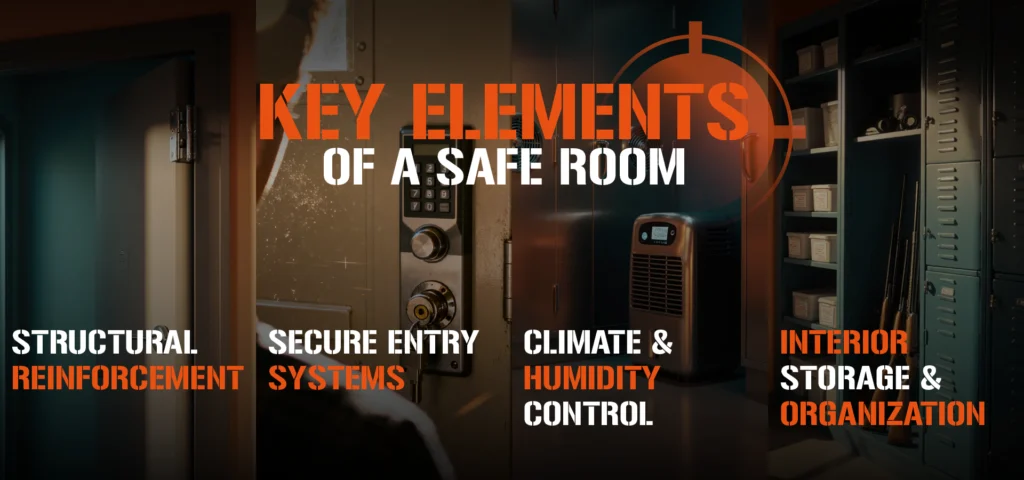
A safe room doesn’t rely on a single feature to do all the work. It functions as a system, where each element supports the others.
When one piece is overlooked, the entire space becomes less effective.
Structural Reinforcement
At its core, a safe room starts with the structure itself. The goal isn’t to turn a room into a bunker, but to ensure it can’t be easily compromised, regardless of where you live.
Design considerations often vary based on location, including:
- Local building codes and residential construction standards.
- Regional risks such as storms, flooding, or seismic activity.
- Whether the room is built in a basement, an interior space, or above ground.
Reinforced walls, solid framing, and a door that matches the rest of the room in strength all work together to create consistency instead of weak points.
Secure Entry Systems
Access control is what defines a safe room. If entry isn’t intentional, the rest of the design loses its purpose. You wouldn’t want a safe room without securing the doors, right?
While locking systems differ, the priorities stay the same across regions:
- Compliance with local safety and building regulations.
- Reliability in both powered and non-powered conditions.
- Ease of use without compromising security.
You’ll find that either mechanical or digital locks can be effective. What matters is choosing a system that works consistently in your environment and supports controlled access over time.
Climate and Humidity Control
Environmental conditions vary widely by geography, and they matter.
Climate control becomes especially important in areas with:
- High humidity or coastal air.
- Extreme heat or cold.
- Seasonal temperature swings.
Managing moisture and airflow helps prevent rust, corrosion, and long-term damage, keeping firearms, valuables, and the whole space in usable condition year after year.
Interior Storage and Organization
Storage needs also change depending on location and use.
A well-organized safe room accounts for:
- Available space within the room.
- Local storage or separation requirements.
- Visibility for accountability and inventory awareness.
How to Build a Safe Room
When you decide to build a safe room, there’s something you need to do before jumping into materials and dimensions.
Set your expectations
The clearer your intent, the better every choice that follows.
Planning and Purpose
Before anything is designed or built, you need to be honest about how the room will be used.
Some safe rooms are primarily for storage.
Others are meant to protect people and valuables as well. Many fall somewhere in between.
That distinction affects everything, from layout to access to cost.
At a high level, planning usually comes down to:
- Personal protection: prioritizing controlled access and interior space
- Secure storage: focusing on organization, environment, and accountability
- Mixed use: balancing storage needs with human occupancy and safety
Budget follows purpose. Costs vary widely depending on scope, existing construction, and location.
What matters at this point isn’t hitting a specific number; it’s aligning expectations early so safety doesn’t get compromised later.
Choosing the Right Location
Where a safe room sits inside a home or building matters just as much as what goes into it.
Accessibility and discretion are often in tension.
A room that’s too hidden may be difficult to use correctly. A room that’s too exposed may draw unnecessary attention.
The right balance depends on layout, daily routines, and who needs access.
Location decisions should also avoid structural tradeoffs. Cutting into load-bearing elements or forcing a room into a space that wasn’t meant to support it can introduce risks that undermine the entire idea of safety.
Working With Professionals
Contractors, locksmiths, and compliance professionals help ensure that the room functions as a system, not a collection of parts.
They understand local codes, structural limits, and access control in ways online tutorials don’t.
DIY shortcuts may look cost-effective upfront, but they often create blind spots: weak points in structure, unreliable access, or non-compliant storage.
Trust us, you don’t want to DIY your way around your family’s safety.
Common Mistakes to Avoid When Designing a Safe Room
Most mistakes come from focusing too hard on one aspect of safety while overlooking how the room actually works day to day. We get it, having a safe room might feel like an exciting project, but you need to put practicality before anything else.
Over-Fortifying Without Planning Access
- Prioritizing strength over usability.
- Creating entry systems that are slow or frustrating to use.
- Encouraging shortcuts that weaken security over time.
Ignoring Humidity Control
- Assuming locks and walls are enough.
- Overlooking moisture in basements or enclosed spaces.
- Discovering corrosion only after damage has started.
Poor Key or Code Management
- Sharing access temporarily and never revisiting it.
- Losing track of who has keys or codes.
- Failing to update access as circumstances change.
Focusing on Security but Ignoring Safety
- Designing for intrusion without considering daily use.
- Cluttered or poorly organized interiors.
- Creating a space that feels secure but functions unpredictably.
Is a Safe Room Right for You?
Do You Need More Than Basic Storage?
A safe room starts to make sense when locking a firearm away no longer feels like the full solution.
If you’re thinking about access control, environmental protection, and reducing risk across firearms, valuables, and people, a safe room provides structure that a single container can’t.
Is a Gun Safe Enough for Your Setup?
Most of the time, a high-quality gun safe is enough. A safe room isn’t automatically better; it only adds value when your needs begin to exceed what a single unit can reasonably manage.
Are You Protecting More Than Firearms?
Take a look at your priorities if you are protecting important documents, high-value items, or creating a more secure area within your home.
A safe room allows safety to serve multiple purposes under one controlled space. That broader use is often what pushes the decision from maybe to yes.
What Level of Control Do You Actually Want?
The real question isn’t whether a safe room is more secure. It’s whether it gives you better control over access, environment, and long-term safety than what you’re using now.
When it simplifies responsibility instead of giving you a headache, it’s likely the right move.
Frequently Asked Questions About Safe Rooms
What qualifies as a safe room?
A safe room is a reinforced, access-controlled space designed to protect people, valuables, or sensitive items. Unlike a single safe, it functions as a system, combining structure, controlled entry, and interior organization to reduce risk and improve accountability.
Is a safe room the same as a panic room?
No.
A panic room is designed for short-term protection during an immediate threat. A safe room is built for everyday use, focusing on prevention, controlled access, and long-term protection rather than emergency reaction.
Do safe rooms have to be used for firearms?
Not at all. While safe rooms are commonly used for firearm storage, they’re also used to protect valuables, important documents, and people. Firearms may be part of the purpose, but they’re rarely the only one.
Are safe rooms legal?
Safe rooms themselves are legal, but firearm storage laws vary by location. A safe room can help support compliance, but it’s important to verify local regulations regarding access, storage, and safety requirements.
How expensive is it to build a safe room?
Costs vary widely depending on size, location, existing construction, and purpose. A safe room can range from a modest upgrade to a more comprehensive build. The key is planning around use, not overbuilding without intention.
Is a safe room worth it?
A safe room is worth it when it simplifies responsibility instead of adding complexity. If it improves control, accountability, and peace of mind over your current setup, it’s doing its job.